
Jintao Ke
Dr. Jintao Ke is an Assistant Professor in the Department of Civil Engineering at the University of Hong Kong (HKU). Dr. Ke received his B.S. degree (2016) in Civil Engineering from Zhejiang University, and his PhD degree (2020) in Civil and Environment Engineering from Hong Kong University of Science and Technology. Prior to joining HKU, he was a Research Assistant Professor in the Hong Kong Polytechnic University. His research interests include on demand mobility services, transportation big data analytics, multimodal transportation system optimization, transportation pricing, spatiotemporal traffic prediction, etc. The vision of his research is to develop novel models, algorithms, and conduct data-driven quantitative analyses to better manage, operate, and regulate various types of emerging mobility services. He has published more than 60 SCI/SSCI indexed research papers in top-tier journals in the field of transportation research and data mining, such as Transportation Research Part A–F, IEEE Transactions on Intelligence Transportation System, IEEE Transactions on Knowledge and Data Engineering, IEEE Internet of Things, Computer-Aided Civil and Infrastructure Engineering. He has been ranked as the World’s Top 2% most-cited scientists by Stanford University since 2023 and was awarded the Honorable Mention of HKSTS Outstanding Dissertation Award in 2020. He is serving as an Associate Editor of Travel Behavior and Society, and an Editorial Board Member of Transportation Research Part C, Transportation Research Part E, and Transportmetrica A: Transport Science.
Research Profile
- Co-authored over 60 peer-reviewed journal articles by June 2026.
- Received more than 6,800 Google Scholar citations with an H-index of 35.
- Ranked among the World’s Top 2% Scientists by Stanford University and Elsevier from 2023 to 2025.
- Listed as a Top 1% Scholar by Clarivate Analytics’ Essential Science Indicators in 2025.
- Acquired over HK$14 million from 10 external research grants as PI or Project Coordinator since joining HKU.
Selected Honors
- Meritorious Service Award, Transportation Science, 2025.
- Best paper award in the 15th International Workshop on Computational Transportation Science (CTS), June 2024.
- Best poster paper award in the 2023 World Transportation Convention, 2023.
- HKSTS Outstanding Dissertation Award (Honorable Mention), Hong Kong, August 2020.
- PhD Research Excellence Awards at School of Engineering (Final List), Hong Kong University of Science and Technology, Hong Kong, August 2020.
- Best poster paper award in the 19th COTA International Conference of Transportation and Professionals, July 2019.
- Best paper award in the 9th International Workshop on Computational Transportation Science (CTS), July 2017.
Research Interests
- Smart Transportation
- Artificial Intelligence for Transportation
- Spatio-Temporal Traffic Pattern Analysis/Prediction
- Transport Modelling and Economics
- Urban Computing & Smart Cities
- Mobility On-Demand Services (Ride-Sharing, Ride-Sourcing, Last-Mile Delivery)
Featured Research
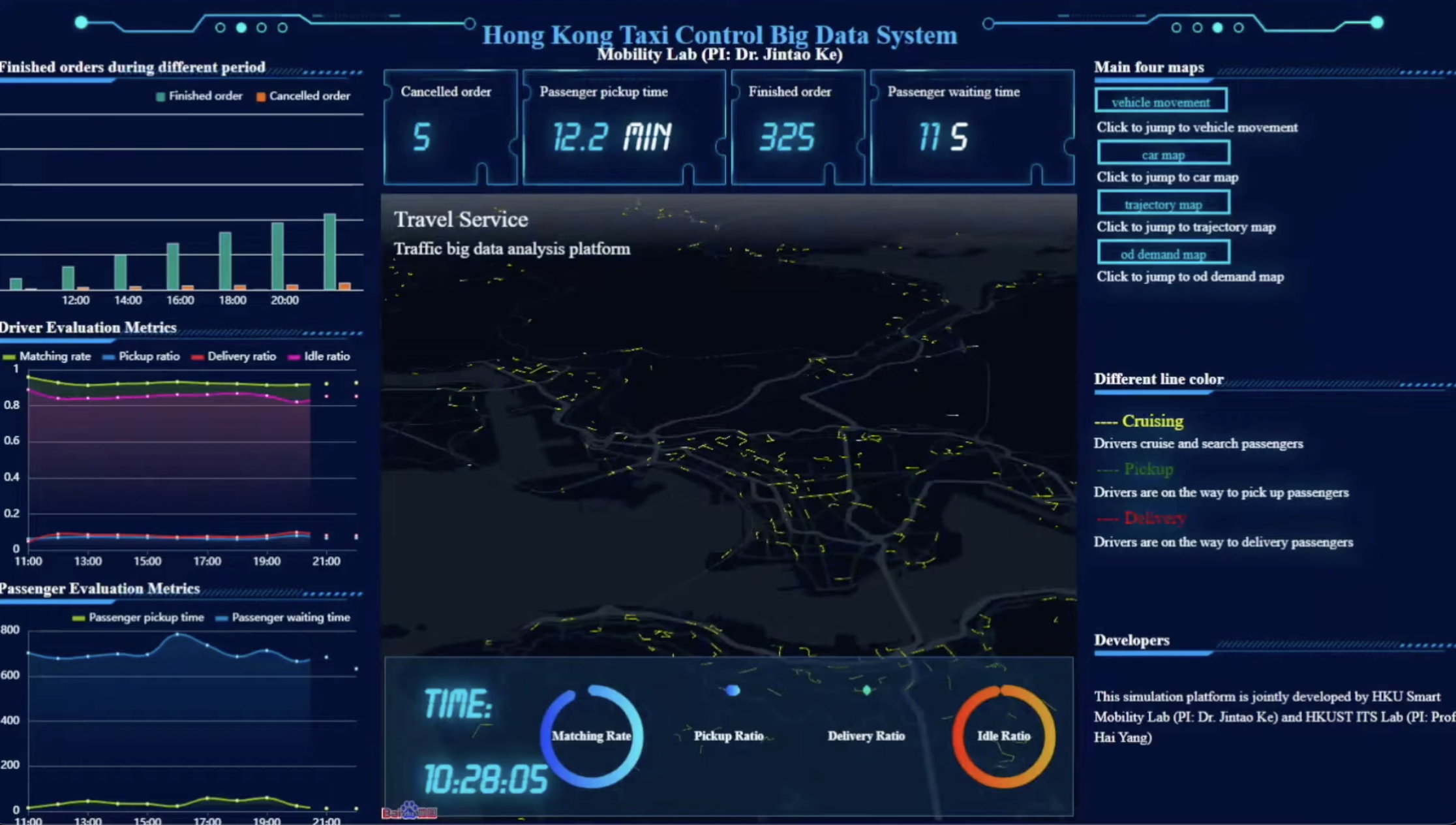
A multi-functional simulation platform for on-demand ride service operations
Abstract
This work introduces an open-source simulator for ride-sourcing operations on real transportation networks. It models passenger and driver behavior and supports algorithm testing for matching, idle-vehicle repositioning, dynamic pricing, and reinforcement learning.
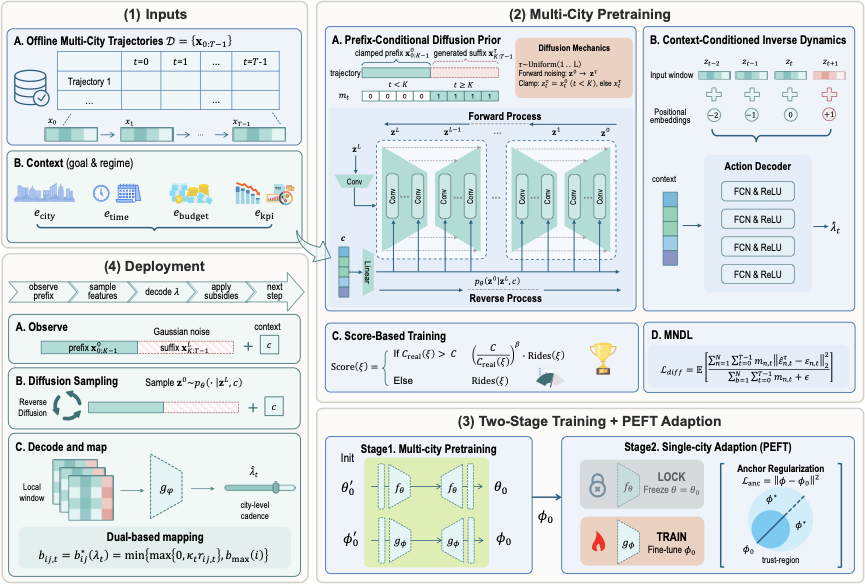
D3-Subsidy: Online and sequential driver subsidy decision-making for large-scale ride-hailing market
Abstract
This paper proposes a deployable city-level subsidy controller for large-scale ride-hailing markets under stochastic supply-demand shocks, strict subsidy caps, and low-latency requirements. The framework combines diffusion-based planning, inverse decoding, and a budget-aware mapping from city controls to order-driver incentives.
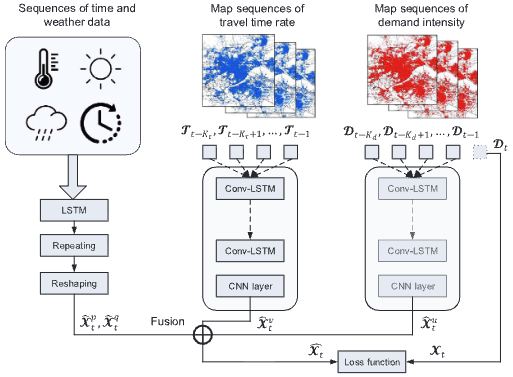
Short-term forecasting of passenger demand under on-demand ride services: A spatio-temporal deep learning approach
Abstract
The study proposes FCL-Net, an end-to-end architecture that fuses convolutional LSTM, standard LSTM, and convolutional layers for short-term ride demand forecasting. Using DiDi data from Hangzhou, it captures spatial, temporal, and exogenous dependencies and improves prediction over classical and neural baselines.
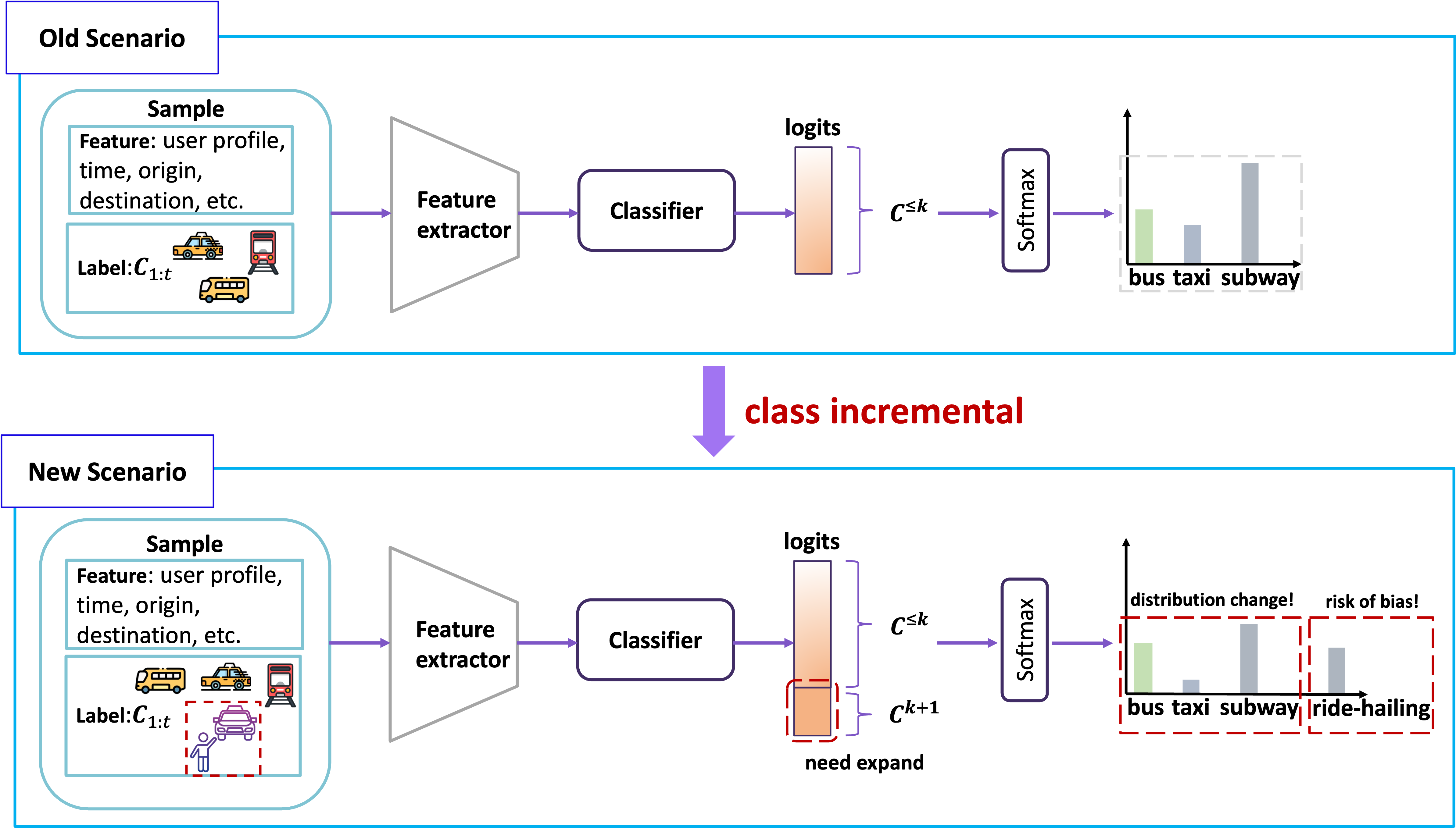
Addressing the online incremental transport mode choice prediction problem with an LLM-augmented class-incremental learning approach
Abstract
This work formulates incremental transport mode choice prediction for settings where new mobility options appear over time. ITMCP-LAR combines streaming updates, LLM-based few-shot augmentation, an expandable classifier, and replay-based class-incremental learning to balance adaptation and memory.
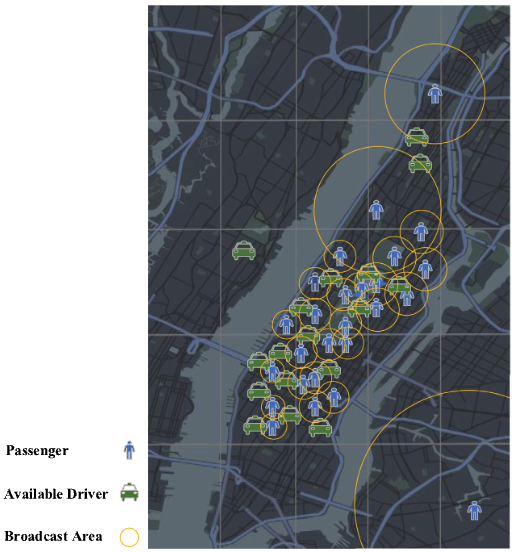
Dynamic matching radius decision model for on-demand ride services: A deep multi-task learning approach
Abstract
The paper develops DL-MRD for dynamically choosing matching radii under a broadcasting ride-hailing mode. The model predicts multiple system metrics across candidate radii and uses a weighted multi-task strategy to improve fulfillment, utilization, waiting time, and platform revenue outcomes in simulation.
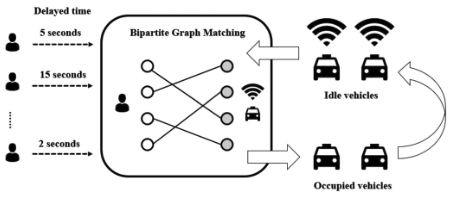
Learning to delay in ride-sourcing systems: A multi-agent deep reinforcement learning framework
Abstract
This paper studies delayed matching as a strategic decision in ride-sourcing systems. A two-stage framework uses multi-agent deep reinforcement learning to decide request delay times and bipartite matching to improve the tradeoff among pick-up time, matching time, and successful matching rate.
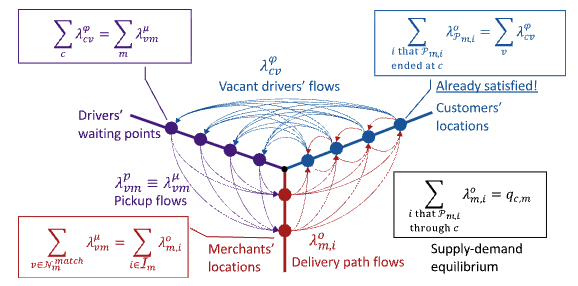
A three-sided network equilibrium model for on-demand food delivery services
Abstract
This work builds a Stackelberg, three-sided network equilibrium model for customers, delivery drivers, and merchants in on-demand food delivery. It integrates batch matching and bundled delivery dispatching to evaluate pricing, fleet, bundling, and operational strategies with real-world data.
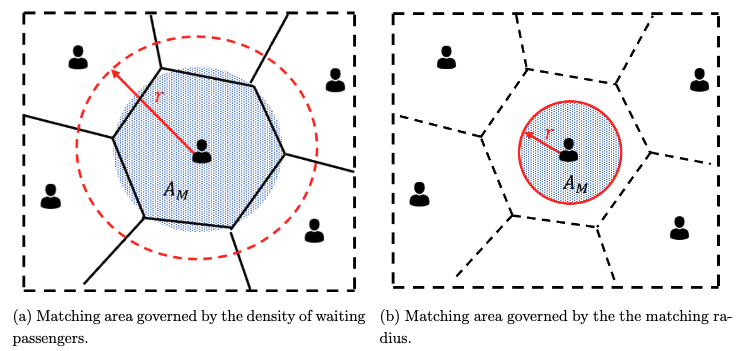
An aggregate matching and pick-up model for mobility-on-demand services
Abstract
The paper introduces the Aggregate Matching and Pick-up model to approximate online matching and physical pick-up in stationary mobility-on-demand markets. It links demand, fleet size, matching intervals, and matching radii to passenger waiting time and driver idle time while unifying several existing matching models.
* Corresponding author